

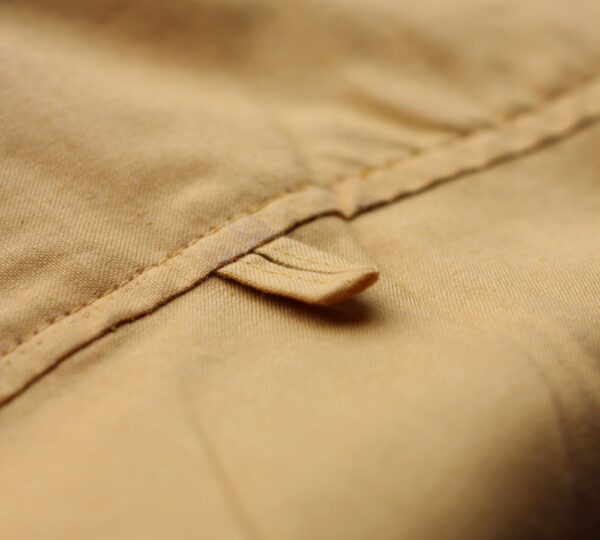
If you own a classic button-down shirt, chances are you’ve seen a small fabric loop stitched just below the collar on the back. For many, it’s a detail that goes unnoticed.
For others, it’s something noticed once or twice, often assumed to be purely decorative or perhaps a leftover remnant from manufacturing.
I was in the latter group for years. Like many people, I assumed the loop was inconsequential—a tiny feature that didn’t really matter.
But once I learned its story, I realized this modest piece of fabric carries a rich history, practical purpose, and a subtle nod to tradition that spans more than a century.
What seems like a minor design detail actually reflects decades of thoughtful craftsmanship, military necessity, and cultural evolution.
Understanding it requires stepping back in time, to an era when clothing was designed first and foremost for utility, and every stitch had a purpose.
A Detail Born From Necessity
To truly appreciate the back-of-collar loop, often called a locker loop or backstay loop, we need to journey back to the early 1900s.
At that time, clothing was not designed primarily with fashion in mind, especially in military contexts.
Function came first, and for members of the United States Navy, practicality wasn’t optional—it was a matter of daily survival and efficiency.
Sailors lived in incredibly tight quarters aboard ships. Personal space was minimal, and storage was scarce. Closets, as we know them today, were rare.
Sailors had to keep their belongings organized, clean, and dry.
Uniforms, including shirts, needed to stay wrinkle-free and ready to wear despite being exposed to the elements at sea.
The solution was deceptively simple: add a small, sturdy fabric loop to the back of the shirt’s collar.
This loop allowed sailors to hang their shirts on hooks rather than folding them or leaving them in a pile on a bunk.
Hanging shirts in this way helped maintain their shape, kept them off the floor, and reduced wrinkling. It was practical, efficient, and required no additional equipment.
At this stage, the loop was not a design flourish, a mark of craftsmanship, or a status symbol. It was purely functional—a tiny yet essential feature born out of necessity.
Sailors called it the locker loop, as it allowed shirts to hang neatly in shipboard lockers, although sometimes it was also referred to as the backstay loop in nautical circles.
From Naval Necessity to Everyday Fashion
Over time, military influence on civilian clothing grew, and functional details began migrating from service uniforms into everyday wear.
Button-down shirts, particularly those made from durable cotton, transitioned from ship decks and naval bases into broader American wardrobes.
By the mid-20th century, the locker loop had made its way into the world of casual and semi-formal menswear.
While its original practical purpose—to hang a shirt neatly in a sailor’s quarters—was largely obsolete for civilians, the loop remained a staple.
Designers and manufacturers chose to preserve it, signaling a subtle appreciation for the shirt’s heritage and craftsmanship.
In this period, the loop started to take on a symbolic meaning beyond function.
It became associated with quality and attention to detail, subtly differentiating higher-quality shirts from cheaper mass-produced alternatives.
For many, the loop was a quiet reminder that even seemingly small details could carry significance.