
It was a rainy Tuesday evening, just twenty minutes before closing time at my small neighborhood bakery. I was wiping down the counters, thinking about the bills I had to pay, when the bell above the door chimed.
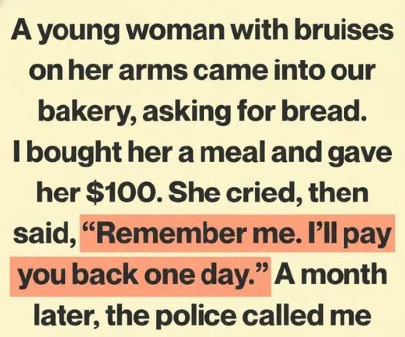
In walked a young woman. She looked exhausted, her clothes were dampened by the rain, and as she reached for a loaf of bread, I noticed the heavy purple bruises lining her forearms. She didn’t look like a customer; she looked like someone who had been through a war.
When she reached the counter, she whispered, “I don’t have enough for the whole loaf. Can I just buy two slices?”
My heart sank. I knew a few slices of bread weren’t going to fix whatever she was running from. I didn’t just give her the bread; I packed a heavy bag with sandwiches, pastries, and juice. Then, acting on an impulse I can’t explain, I reached into the register and handed her a $100 bill—the last of my profit for the day.
She stared at the money, her eyes filling with tears. She didn’t say thank you right away. Instead, she gripped my hand and whispered, “Remember me. I’ll pay you back one day.”
The Phone Call
Exactly thirty days later, the atmosphere in the bakery shifted from flour and sugar to cold anxiety. Two police officers walked in and asked for me by name. My heart hammered against my ribs. Had I been dragged into something illegal? Was that girl a criminal? Was I in trouble for helping her?
I followed them to the station in a daze, bracing for the worst.
The Twist
When I arrived, I wasn’t taken to an interrogation room. Instead, I was led to a private office. Sitting there, looking healthy, vibrant, and dressed in a professional suit, was the woman from the bakery.
She stood up and hugged me. “I told you I’d pay you back,” she said.
She explained that she wasn’t a runaway or a criminal. She was the daughter of a prominent tech CEO who had been kidnapped for ransom. She had managed to escape her captors, but with no phone and no money, she was hiding in the streets, terrified that anyone she asked for help might turn her back in for the bounty.
“That $100 didn’t just buy me a bus ticket out of the city,” she told me. “It gave me the courage to trust the world again. It was the first sign of humanity I had seen in weeks.”
The Reward
She didn’t just hand me back my $100. She handed me a legal folder. Her family had purchased the entire block where my bakery stood. They weren’t evicting me; they were giving me the deed to my shop, debt-free, along with a grant to renovate it into the flagship cafe I had always dreamed of.
The Moral of the Story: We often think we need to change the world with grand gestures. But sometimes, the world changes because you decided to be kind to a stranger when they had nothing to offer you in return.
Kindness is never an expense; it’s an investment that the universe always pays back with interest.