
Weddings are supposed to be joyful moments. They are meant to feel like a celebration of love, commitment, and hope for the future.
That day, everything looked exactly as it should.
The flowers were perfect. The guests were smiling. The music filled the room with warmth and anticipation.
And yet, in the middle of what was meant to be one of the happiest moments of my life, a single sentence shifted everything.
My mother-in-law stood up, took the microphone, and smiled broadly.
“I’m so happy my son found a woman who knows how to follow the family way,” she said, her eyes settling on me for just a moment too long.
The room reacted instantly. Laughter rippled through the crowd. Some guests nodded politely. Others looked confused.
I smiled as well.
But inside, my chest tightened.
My heart was pounding so loudly that I could barely hear the next words spoken by the officiant.
In that moment, I understood something very clearly.
If I stayed quiet, nothing would ever change.
A Pattern I Had Learned to Tolerate
My name is Laura, and I was thirty-two years old when I decided to marry Daniel.
We had been together for four years. Our relationship was loving, supportive, and built on shared goals.
But from the very beginning, there was another presence in our relationship.
His mother, Patricia.
She had strong opinions about everything. How the house should look. How holidays should be celebrated. What decisions were “appropriate” for a married couple.
At first, I tried to see it as concern.
Then as tradition.
Eventually, I realized it was control disguised as care.
Patricia often spoke about me as if I were quiet and agreeable, even though that wasn’t who I was. I chose my words carefully around her, not because I was afraid, but because I believed peace was worth patience.
I told myself that marriage would bring balance.
I was wrong.
The Wedding She Had Carefully Designed
The ceremony took place at a charming countryside hotel near Toledo.
It was elegant. Traditional. Exactly the kind of wedding Patricia had always envisioned for her son.
Every detail reflected her influence.
The seating. The music. Even the wording of certain speeches.
Daniel and I stood together, ready to exchange vows, when Patricia’s comment echoed through the room.
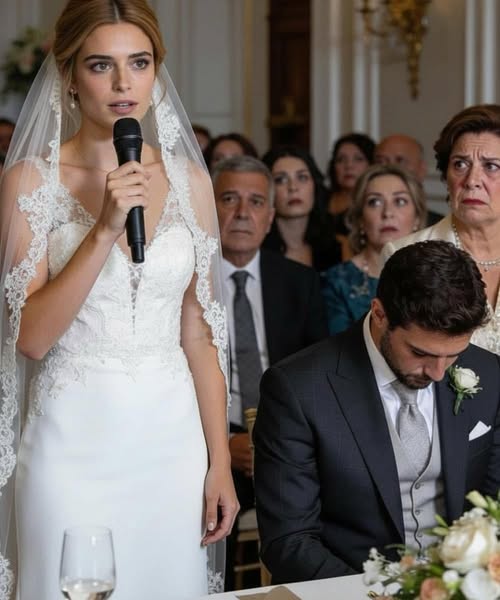
As the officiant prepared to continue, I raised my hand.
My voice was steady, even though my hands were trembling.
“Before we move on,” I said, “I need to say something.”
A hush fell over the room.
Daniel turned to me, his expression caught between surprise and worry.
Patricia’s smile disappeared.
Choosing My Voice at the Altar
I took a deep breath.
“I’m not only starting a marriage today,” I said. “I’m also closing a chapter of my life. One where I stayed quiet for the sake of comfort.”
People shifted in their seats.
“I’ve listened carefully over the years,” I continued. “I’ve observed. I’ve reflected.”
Patricia crossed her arms.
“There have been many moments when I was told how I should act, speak, or decide. Always framed as guidance. Always presented as concern.”
I looked directly at her.
“But there are things that should not stay hidden if this marriage is going to be built on honesty.”
The room was silent.
Even the officiant stepped back.
The Truth I Had Carried Quietly
Three months before the wedding, I received an email from an unknown sender.
The subject line read: “You deserve to know this.”
At first, I almost deleted it.
But something told me to open it.
Inside were documents, messages, and financial records that left me stunned.
They were not about Daniel.
They were about Patricia.
I discovered that she had been involved in decisions that Daniel and I believed we were making together.
She had contacted his former employer to discourage him from accepting a position in another city, worried that distance would weaken her influence.
She had arranged a loan in Daniel’s name for wedding expenses without discussing it with us first, then later used it to apply emotional pressure.
She had even spoken to my mother privately, planting doubts about my personality and intentions.
The most painful discovery was learning that she had pushed Daniel toward legal arrangements and commitments without my knowledge, assuming I would simply accept whatever was presented.
A Difficult Conversation Before the Ceremony
When I confronted Daniel, he didn’t deny it.
He broke down.
He admitted that he had grown up following his mother’s lead and had never learned how to set boundaries.
He apologized sincerely.
I believed him.
But I also made one thing very clear.
If we were going to marry, our relationship could not continue with silence and avoidance.
The truth needed daylight.
And he needed to stand beside me.
Speaking With Calm, Not Anger
Back at the ceremony, I shared only what was necessary.
I did not accuse. I did not embarrass anyone.
I spoke calmly.
“Some of the choices I thought were ours were influenced without my knowledge,” I said. “That is not how partnerships grow.”
Patricia interrupted, saying this was not the time or place.
I met her gaze.
“The right time would have been mutual respect,” I replied gently.
I turned to Daniel.
“I love you,” I said. “But love cannot thrive where there is silence and control.”
Daniel stepped forward.
“My mother overstepped,” he said, his voice unsteady but firm. “And I allowed it. That ends today.”
The room exhaled.
Some guests looked stunned.
Others nodded quietly.
A Wedding That Became Something Deeper
The officiant asked if we wished to continue.
Daniel took my hand.
“Yes,” he said. “If she chooses to.”
I looked at him.
For the first time, I saw resolve replacing fear.
“Yes,” I answered. “Now, yes.”
The ceremony moved forward.
It wasn’t flawless.
But it was honest.
What Changed After That Day
The months that followed were not easy.
Patricia tried to soften the story. She spoke of misunderstandings and intentions.
But something had shifted.
Daniel canceled the loan.
We made decisions together, independently.
When unsolicited advice appeared, he addressed it respectfully but firmly.
I changed too.
I stopped smiling out of obligation.
I learned that peace does not require silence.
One year later, we live in a different city.
Not to escape.
But to grow.
Patricia remains part of our lives, but the dynamic is different now. Boundaries exist. Conversations are clearer.
The power she once held faded when honesty replaced avoidance.
A Lesson I Carry Forward
People often ask if I regret speaking up on my wedding day.
I don’t.
Because that moment was not about conflict.
It was about clarity.
It was about choosing a marriage built on mutual respect, not quiet compliance.
This story is not about blame.
It is about understanding how easily control can hide behind tradition.
And how courage sometimes shows up at the most unexpected moment.
If this story resonates with you, perhaps it’s because you’ve faced a similar crossroads.
Sometimes, finding your voice changes everything.