
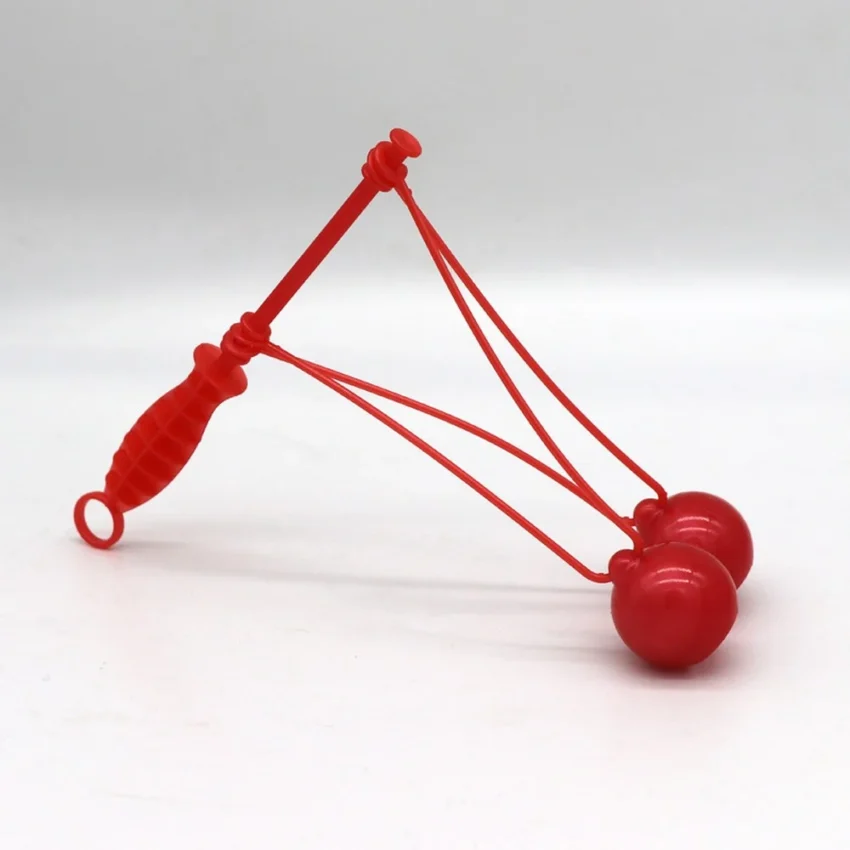
In an era long before smartphones, video games, and digital entertainment, a remarkably simple toy managed to capture the imagination of an entire generation. Known as Clackers, the toy consisted of just two hard plastic balls connected by a string —
yet during the late 1960s and early 1970s, it became a full-blown cultural phenomenon. For many people today, the toy looks puzzling and unremarkable, but for millions of children at the time, Clackers represented skill, rhythm, and social status on playgrounds across America.
What made Clackers special was their deceptively simple design paired with surprising difficulty. Players had to master timing and coordination to swing the balls so they collided above and below the hand, producing the iconic “clack-clack” sound that echoed through neighborhoods. Beginners often struggled, while experienced players could perform fast, controlled sequences that impressed crowds of friends. The toy rewarded patience, practice, and physical skill, turning play into a form of performance and friendly competition.
The Clacker craze was fueled by Wham-O, the legendary toy company behind the Hula Hoop and Frisbee. Introduced in 1969, Clackers quickly exploded in popularity, with millions sold in a single year. Television ads, store demonstrations, and word of mouth helped spread the trend, and soon schoolyards were filled with rhythmic clicking sounds. However, the toy’s rapid rise also brought concerns. The hard plastic balls sometimes shattered after repeated impacts, causing injuries and prompting schools and parents to ban them, which eventually led to their decline.

Despite their short time in the spotlight, Clackers left a lasting cultural impression. They symbolized a hands-on era of childhood, where play was physical, social, and skill-based rather than screen-driven. Children learned coordination, persistence, and resilience through trial and error, often teaching one another techniques and celebrating progress together. The toy became a small but meaningful lesson in focus and mastery, reflecting the values of a generation that learned by doing.

Today, Clackers live on as a nostalgic treasure, cherished by collectors and fondly remembered by those who grew up with them. Vintage sets are prized, and their familiar sound still sparks memories of summer afternoons, playground friendships, and simple joy. In a modern world dominated by digital experiences, Clackers remain a reminder that sometimes the most powerful fun comes from the simplest things — a bit of rhythm, a bit of patience, and the shared happiness of mastering something with your own hands.