
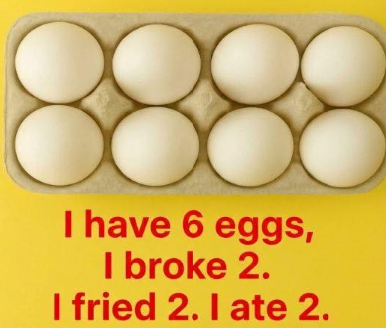
Brain teasers have a special way of capturing attention because they invite us to pause, think, and look at everyday ideas from a new angle. Unlike standard math problems, many popular riddles are built around language and logic rather than numbers alone.
They are designed to gently trick the mind, encouraging readers to slow down and question their first assumptions. One of the most well-known examples shared online and in classrooms is the classic “six eggs” riddle, which continues to spark debate precisely because it appears much simpler than it actually is.
The puzzle is usually phrased in a straightforward way: “I have six eggs. I broke two, fried two, and ate two. How many eggs are left?” At first glance, the wording seems to describe three separate actions involving different eggs. Because of that, many people instinctively add the numbers together and assume that all six eggs must be gone. This quick answer feels logical and satisfying, which is why so many readers stop there. The riddle works because it takes advantage of how easily we skim information and fill in gaps without fully analyzing what is being said.
A closer look, however, reveals the clever twist hidden in the language. To fry an egg, it must first be broken, and to eat an egg, it must already be cooked. That means the actions described in the riddle are not separate at all. The same two eggs were broken, then fried, and finally eaten. No extra eggs were involved in those steps. The remaining eggs were never touched. The puzzle rewards careful reading and logical sequencing rather than quick arithmetic, highlighting how small details can completely change the outcome.
When viewed this way, the answer becomes clear and surprisingly simple. You began with six eggs, used only two throughout the entire process, and left the other four untouched. So, four eggs remain. This riddle is a lighthearted reminder that effective problem-solving often depends on patience and attention to wording. By slowing down and thinking through each step, we can avoid common mental shortcuts and arrive at clearer, more accurate conclusions—both in puzzles and in everyday life.