
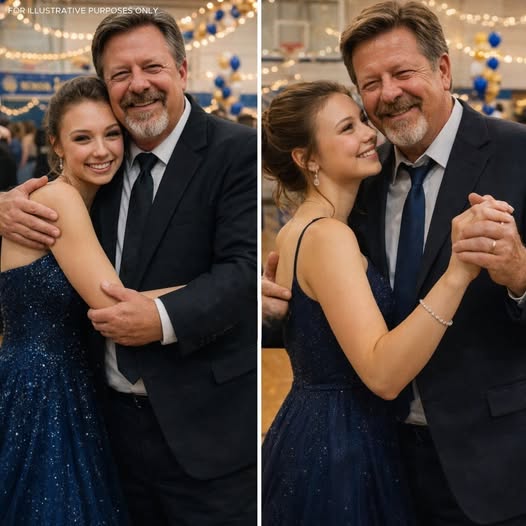
I was eighteen the year I finally learned how loud silence could be.
My name is Brynn, and for most of high school, my identity arrived before I did. It slipped into rooms ahead of me, took a seat, and waited. People didn’t need introductions. They already knew.
I was the janitor’s daughter.
My dad’s name is Cal. He works at my high school, the same red brick building with chipped steps and humming fluorescent lights that shaped four years of my life. He is the first person inside it every morning, unlocking doors while the sky still looks undecided about becoming day. The hallways belong to him then. Empty lockers breathe out cold air. The floors shine faintly, smelling of cleaner and wax. His footsteps echo softly as he pushes his cart from one wing to another, keys clinking at his hip.
Most people only notice the work he does when it hasn’t been done yet. When a trash can overflows. When a bathroom smells wrong. When a light flickers instead of turning on.
He notices everything before that happens.
He scrapes gum from bleachers long after football crowds leave. He wipes sticky soda rings off cafeteria tables. He replaces broken handles, tightens loose bolts, changes lightbulbs people forgot existed. He does it quietly, without announcements, without expecting anyone to look up and say thank you.
And then he comes home and asks me how my day was.
When I was fourteen, none of that felt noble. It felt dangerous.
Freshman year had barely started when a boy in my math class leaned across the aisle, smirking like he had discovered something clever.
“So,” he said, loud enough for half the room to hear, “do you get special trash privileges or something?”
For half a second, I didn’t understand what he meant. Then I felt every eye swing toward me, curious and sharp.
The room erupted.
Laughter slammed into my chest. My ears rang. My face burned so fast I thought I might pass out. I laughed too, a thin sound that didn’t belong to me, because at fourteen you learn quickly that laughing can sometimes stop the bleeding.
After that day, my name became optional.
People called me Mop Princess. Swiffer Girl. Someone asked, genuinely amused, if my dad planned to bring a plunger to prom one day.
Each joke landed lightly enough to seem harmless, but together they added weight. I carried it everywhere. It bent my shoulders forward. It made me smaller.
I stopped posting pictures of my dad online. If I saw him in the hallway, I slowed my pace or pretended to scroll through my phone. Sometimes I walked a few steps behind him, telling myself it was nothing, that it didn’t mean anything.
It meant everything.
At night, I hated myself for it. I lay in bed listening to the house settle, replaying moments I wished I could redo. I wanted to be braver. I wanted to be proud. Mostly, I wanted to be invisible.
My dad never reacted the way I expected.
If students mocked him within earshot, he smiled and kept wiping counters. If teachers talked around him instead of to him, he nodded politely. If someone spilled a drink across a freshly cleaned floor, he grabbed the mop without a sigh.
At home, he was softer. He asked about quizzes and group projects. He packed my lunches in brown bags, folding the tops carefully. He hummed while folding laundry, songs my mom used to sing before she was gone.
She had gotten sick when I was nine. One year she was there, braiding my hair before school, and the next she wasn’t. After that, it was just us.
We learned how to function as a pair. He worked longer hours. I learned to make simple dinners. We learned how to talk around the empty space without naming it.
By senior year, prom season arrived with all the subtlety of a spotlight. It was everywhere. In the halls. On social media. In conversations that buzzed with talk of limos, after parties, and dresses that cost more than our monthly grocery budget.
I told anyone who asked that I wasn’t going.
“I don’t care about prom,” I said, over and over, until it almost sounded convincing.
The truth was, I cared too much.
One afternoon, my guidance counselor stopped me near the office. She had a folder tucked under her arm, the kind stuffed with college applications, scholarship forms, and financial planning brochures that mentioned things like student loans, insurance paperwork, and future careers.
“You know your dad’s been staying late all week, right?” she asked.
I shrugged. “He always stays late.”
“Not like this,” she said. “He’s been helping set up for prom. Lights, tables, decorations. He refused overtime.”
She hesitated before adding, “He said it was for the kids.”
That night, I found my dad at the kitchen table with a calculator and a stack of papers spread out like a puzzle. The overhead light cast shadows across his hands. His brow was creased, the same way it got when he tried to make numbers line up.
“What’s that?” I asked.
He startled, then smiled. “Just budget stuff.”
I sat anyway.
That’s when I saw the scrap of paper, folded once, tucked between utility bills and grocery receipts.
Rent.
Groceries.
Gas.
Electric.
Brynn dress??
The question marks felt louder than the laughter ever had.
Something inside me gave way.
“I’m going,” I said, before I could lose my nerve.
He looked up. “Going where?”
“Prom.” My voice shook, but I didn’t stop. “I want to go.”
For a moment, his face held too many emotions to name. Surprise. Pride. Fear. The kind that comes from wanting to give someone everything and not knowing if the numbers will cooperate.
“We’ll figure it out,” he said finally.
And we did.
The following Saturday, we drove across town to a thrift store squeezed between a payday loan office and an insurance agency advertising free quotes in bright letters. Inside, the air smelled like old fabric and dust and something hopeful.
We searched rack after rack. My fingers brushed sequins, satin, lace. Then I found it.
A dark blue dress, simple and elegant. It fit like it had been waiting.
When I stepped out of the dressing room, my dad froze.
“You look like your mom,” he said quietly.
I had to swallow hard to answer.
Prom night came too fast.
As I stepped out of my dad’s old Corolla, my heart hammered. Whispers followed me like static. I forced myself to keep walking.
Inside the gym, lights shimmered. Music pulsed. Dresses caught the glow.
Then I saw my dad.
He stood near the back wall in a plain black suit, work shoes still on his feet, a trash bag in his hand.
He was still working.
Someone nearby scoffed. “Why is he even here?”
Something inside me snapped, clean and clear.
I walked straight to the DJ booth.
People laughed as I climbed the steps. My hands shook as I took the microphone. The music cut out. Silence spread.
“I’m sorry,” I said. “I just need one minute.”
I looked at the room, then at the man by the wall.
“For four years,” I said, “I haven’t just been Brynn. I’ve been the janitor’s daughter.”
My chest tightened, but I kept going.
The man back there opens this building before any of us arrive. He stays late after games, after dances, after messes we pretend aren’t ours. He fixes what we break. He cleans what we leave behind.
When I finished, the room stayed quiet.
I said the eight words I had carried for years.
“This janitor is my father, my hero always.”
No one laughed.
Someone cried.
Then another.
And everything changed.
The silence after my words did not break all at once. It unfolded.
At first, there was nothing but the low hum of the gym’s lights and the faint echo of my own breathing in the microphone. I could hear my heart thudding, each beat loud and insistent, as if it were trying to finish the speech for me. My fingers were numb around the mic. I had not planned anything beyond those eight words. Everything after them felt like standing on the edge of something deep and unfamiliar.
I looked at my dad.
He had not moved. The trash bag hung loosely from his hand, forgotten. His shoulders, usually set in that steady forward lean of someone who worked on his feet all day, seemed unsure now. His eyes were wide, glassy, reflecting the dance lights that washed the walls in soft blues and purples. I had seen him tired. I had seen him worried. I had never seen him look unmoored.
Someone near the front sniffed. A quiet, broken sound.
Then another.
A girl I recognized from chemistry pressed her hands over her mouth. Her mascara had already begun to smudge beneath her eyes. The football player who used to joke the loudest stared down at his shoes like they had suddenly become very interesting. A teacher near the punch table wiped her cheeks with the edge of her sleeve, not bothering to hide it.
The applause did not explode. It crept in.
One person clapped. Then another. The sound gathered, layered, grew stronger until it filled the room. Chairs scraped as people stood. Hands came together again and again, louder, steadier, until the noise vibrated in my chest.
I felt dizzy.
I stepped down from the DJ booth without looking at anyone else and crossed the floor toward my dad. Each step felt unreal, like walking through water. When I reached him, I took his hand. His palm was rough, familiar, grounding.
He squeezed back hard.
“I didn’t know,” he whispered.
“I know,” I said.
We stood there as the clapping continued, and for the first time, no one was laughing at us.
When the music finally started again, it was softer. Slower. The DJ had chosen something gentle, almost reverent, like the room needed time to breathe. People did not rush back to dancing. Instead, they drifted toward us.
A football player I had seen every day for four years came up first. He shifted his weight awkwardly, then stuck out his hand.
“Thanks for staying late after our games,” he said to my dad. “We never said it.”
My dad nodded, unsure how to respond. “You’re welcome.”
A teacher hugged him without warning. “We don’t say it enough,” she said. “But we should.”
A girl who once whispered Mop Princess behind my back stood in front of us, tears streaking down her face. “My parents never come to school events,” she said quietly. “It matters that you’re here.”
My dad’s eyes filled again. He kept nodding, murmuring soft replies, overwhelmed in a way I had never seen. His work had always been invisible because it was supposed to be. Tonight, it was suddenly illuminated.
I realized then that he had never been unseen. He had simply been overlooked.
We danced.
It was slow and a little awkward. His hands rested carefully at my waist, like he was afraid of stepping on my dress. I rested my head against his shoulder, breathing in the familiar scent of laundry detergent and floor cleaner that always clung faintly to him. Around us, other couples swayed, but none of that mattered.
For those few minutes, the gym felt small. Safe.
Later, when the confetti cannons went off and paper fluttered down like artificial snow, my dad instinctively glanced toward the supply closet.
“Dad,” I said gently. “You don’t have to.”
He smiled sheepishly. “Old habits.”
He stopped anyway.
We left together. No whispers followed us this time. No laughter. Just the cool night air and the sound of our footsteps on the pavement.
In the car, he cleared his throat. “I didn’t know you felt that way,” he said.
“I always did,” I replied. “I was just scared.”
“Me too,” he said, after a pause.
We drove home with the windows cracked, the night quiet and open in front of us.
Years from now, people will forget the decorations, the music, the dress. But I will remember the night I stopped shrinking.
Not because my dad is a janitor.
But because he is a man who works with dignity, loves without conditions, and shows up even when no one claps.
Heroes do not always stand on stages.
Sometimes, they carry mops.
The weeks after prom passed in a strange, softened blur.
School felt different, though nothing about the building itself had changed. The lockers were still dented. The bells still rang too loud. The floors still shone faintly in the mornings because my dad arrived before dawn, just as he always had. But the way people moved through the halls had shifted, almost imperceptibly, like furniture rearranged in a familiar room.
People said my name again.
Not everyone. Not all at once. But enough that I noticed.
A girl from my English class smiled at me in the hallway and asked where I got my dress. A boy who had once joked about trash privileges held a door open and mumbled a quiet hello. Teachers made eye contact when my dad passed, stopping him to say thank you for something small he had fixed weeks earlier.
Nothing dramatic. Nothing loud.
Just different.
At first, I didn’t trust it. I had learned too early how quickly kindness could be revoked. I waited for the jokes to come back, for the moment someone would decide the whole thing had been a performance, a sentimental interruption they were done thinking about.
But it didn’t happen.
Instead, something steadier took its place.
One afternoon, I walked into the building and found my dad laughing with a group of seniors near the vending machines. He had a broom in one hand, leaning on it like a prop. When he saw me, he straightened instinctively, that old habit of making space for students, of shrinking himself.
“Hey, Dad,” I said, loud enough for them to hear.
He smiled, surprised, then waved. “Hey, kiddo.”
The word hung there, ordinary and unremarkable, and for the first time it felt powerful.
We talked more after prom. Not in big speeches or emotional breakdowns, but in small, honest conversations that found us while doing dishes or driving to the grocery store. The air between us felt lighter, like something unspoken had finally been named and set down.
“I didn’t realize you felt ashamed,” he said one night, staring at the sink instead of at me.
“I didn’t realize I was allowed not to be,” I answered.
College acceptance letters arrived soon after. Financial aid packages. Scholarship offers. Paperwork filled with unfamiliar terms about tuition, housing, insurance coverage, meal plans, and future careers. We spread it all across the kitchen table the same way we always had with bills.
Only this time, there was excitement mixed in.
“You’re really going,” my dad said, running a hand through his hair.
“I am,” I said. “We figured it out.”
He nodded slowly, pride settling into his face. “We always do.”
On my last day of school, I stayed behind after the final bell rang. The hallways emptied quickly, voices fading, lockers slamming one last time. I walked down the quiet corridor toward the supply closet where my dad was finishing up.
He looked up when he saw me. “Thought you’d be gone already.”
“I wanted to walk out with you,” I said.
He hesitated, then smiled.
We locked the doors together. The sun was lower now, casting long shadows across the parking lot. As we stepped outside, he paused and glanced back at the building.
“I’ve been thinking,” he said. “I might take some night classes. Maintenance management. Could help with promotions.”
My chest tightened. “You should.”
He shrugged, a little shy. “Never thought much about it before.”
I thought about everything he had taught me without meaning to. About showing up. About dignity. About work that matters even when no one is watching. About managing what you have and still making room for what you dream of.
We drove home with the windows down, summer starting to hum in the air. I leaned my head against the glass and watched the world pass, feeling taller somehow. Not because anyone else had changed.
Because I had.
Years from now, people will forget my speech. They will forget the clapping and the tears and the way the music softened. But I will remember the moment I stopped measuring myself by someone else’s laughter.
Not because my dad is a janitor.
But because he is a man who never needed permission to be proud.
And because, finally, neither did I.